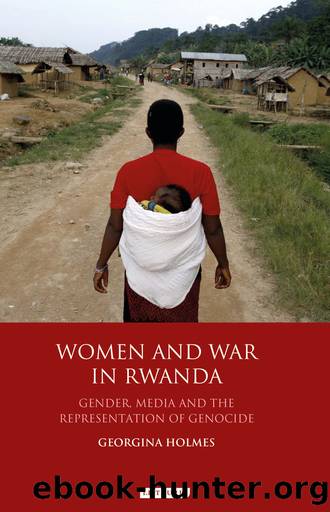
Women and War in Rwanda by Georgina Holmes
Author:Georgina Holmes [Holmes, Georgina]
Language: eng
Format: epub
ISBN: 9780755619016
Google: 0kKjzQEACAAJ
Publisher: I.B. Tauris
Published: 2013-01-15T03:34:24+00:00
Part II: Mediatizing Rwandan women
Former editor of Newsnight (1994â97) Sian Kevill remarked during a Behind the Scenes special, broadcast on 21 February 2002: âIt was very macho, very public school and particularly Oxbridge . . . full of bullshit and . . . sharp shoulders and very competitiveâ, before contending that the Newsnight of the 2000s is âmuch more diverse than it was ten years agoâ.59 Kevillâs statement that Newsnightâs dominant culture in the early 1990s upheld a predominantly white middle-class male view of the world calls for an assessment of the way in which the programmeâs engagement in international politics of revisionism are gendered and how this might have evolved over time in accordance with the editorâs perspective. Like colonial films, Newsnight news features on Rwanda are mediatized spheres within which Rwandan women are stripped of their materiality, dissected under the gaze of the cameraman, journalist and producer, and reconstructed in accordance with the image of politics that fits the documentaryâs narrative. This part of the chapter considers how certain politics of revisionism inform the mediatization of Rwandan womenâs subjectivities and influence the way in which womenâs agency is made visible.
In Fair and Parkâs60 review of the mediatization of the Goma refugee crisis, they contend that limited access to the region and ignorance of political events resulted in an overreliance on stereotypes. An analysis of Newsnight reveals that the war and genocide in Rwanda and continued conflicts in the eastern provinces of the DRC have led to the emergence of new stereotypes and new gendered narratives which over time have changed the way in which Rwandan and Congolese womenâs subjectivities have been mediatized. During the genocide, Newsnightâs reporting tended to adopt a classically western reading of war wherein militarization is understood as a masculine domain from which women are excluded â in spite of the many references to civilian deaths. As in the UK broadsheets, women and children are the subjects of humanitarian crises, although in the first three months they are more often seen than heard. In these stories, women are filmed cooking, washing clothes, tending to children and collecting firewood in refugee camps and rural areas. They are not seen to be engaged in politics and are never filmed as representatives of government or military operations. Rape and SGBV in particular are decidedly absent, despite evidence of rape in the footage included in Peter Marshallâs news feature on the UNâs shaky relationship with Africa, broadcast on 4 May 1994. Images of wounded Rwandan women are often framed by narratives about civil war which suggest they are caught in the crossfire, but not deliberately targeted. For example, in a news feature broadcast on 20 June 1994, International Red Cross hospital scenes focus on a woman who is having shrapnel removed from her leg.
As in the mediatization of the Goma refugee crisis, reporting on the French humanitarian mission Opération Turquoise is highly gendered. Footage of French troops hone in on French masculinity and the helplessness of Hutu women. On
Download
This site does not store any files on its server. We only index and link to content provided by other sites. Please contact the content providers to delete copyright contents if any and email us, we'll remove relevant links or contents immediately.
The Vikings: Conquering England, France, and Ireland by Wernick Robert(84377)
Ali Pasha, Lion of Ioannina by Eugenia Russell & Eugenia Russell(40317)
The Conquerors (The Winning of America Series Book 3) by Eckert Allan W(37956)
The Vikings: Discoverers of a New World by Wernick Robert(37006)
Cecilia; Or, Memoirs of an Heiress — Volume 1 by Fanny Burney(32636)
Cecilia; Or, Memoirs of an Heiress — Volume 2 by Fanny Burney(32010)
Cecilia; Or, Memoirs of an Heiress — Volume 3 by Fanny Burney(31996)
Empire of the Sikhs by Patwant Singh(23135)
The Secret History by Donna Tartt(19293)
Hans Sturm: A Soldier's Odyssey on the Eastern Front by Gordon Williamson(18649)
Cat's cradle by Kurt Vonnegut(15441)
Pimp by Iceberg Slim(14664)
Sapiens: A Brief History of Humankind by Yuval Noah Harari(14458)
Norse Mythology by Gaiman Neil(13457)
Talking to Strangers by Malcolm Gladwell(13439)
Leonardo da Vinci by Walter Isaacson(13411)
4 3 2 1: A Novel by Paul Auster(12509)
Underground: A Human History of the Worlds Beneath Our Feet by Will Hunt(12144)
The Radium Girls by Kate Moore(12090)
